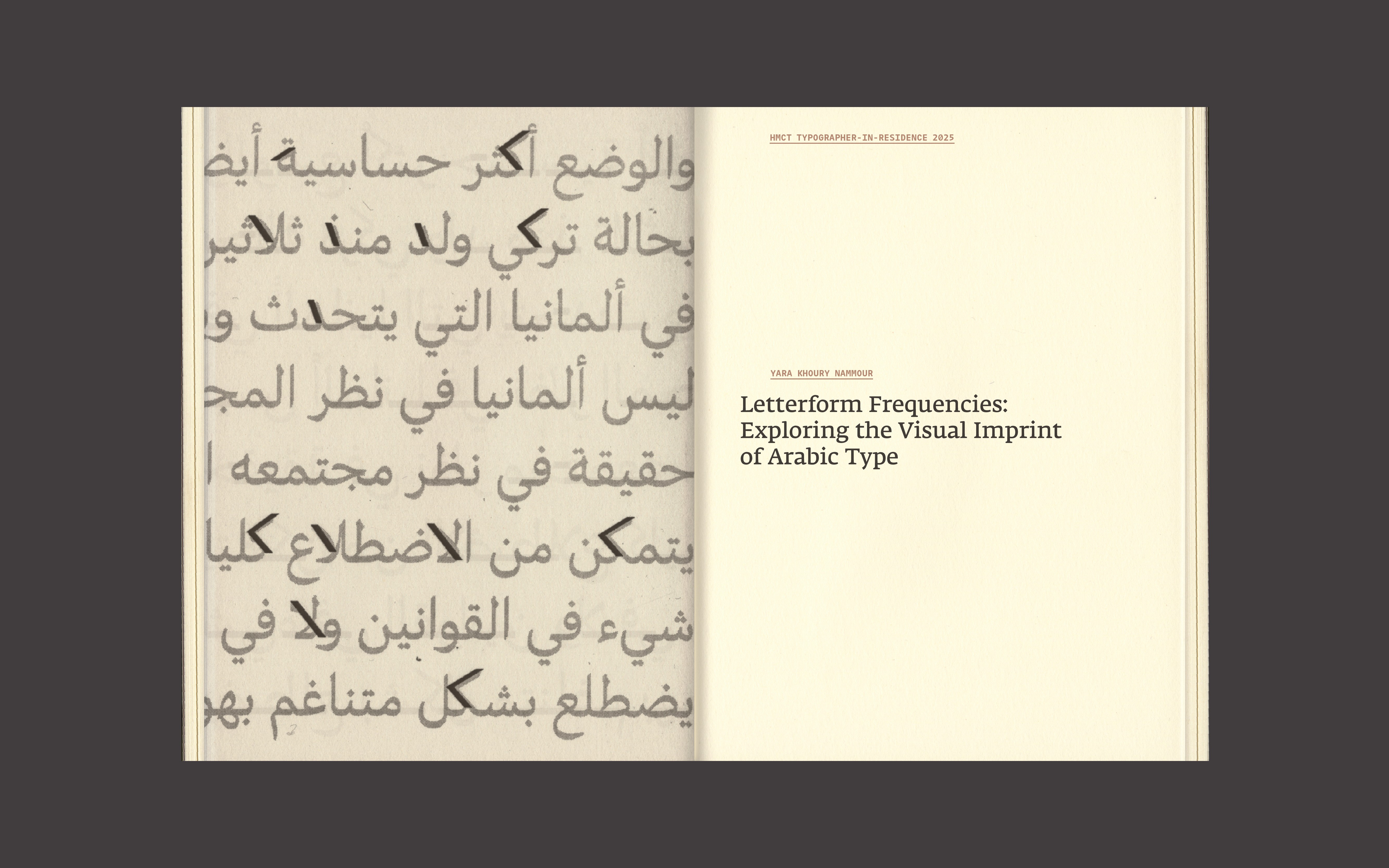
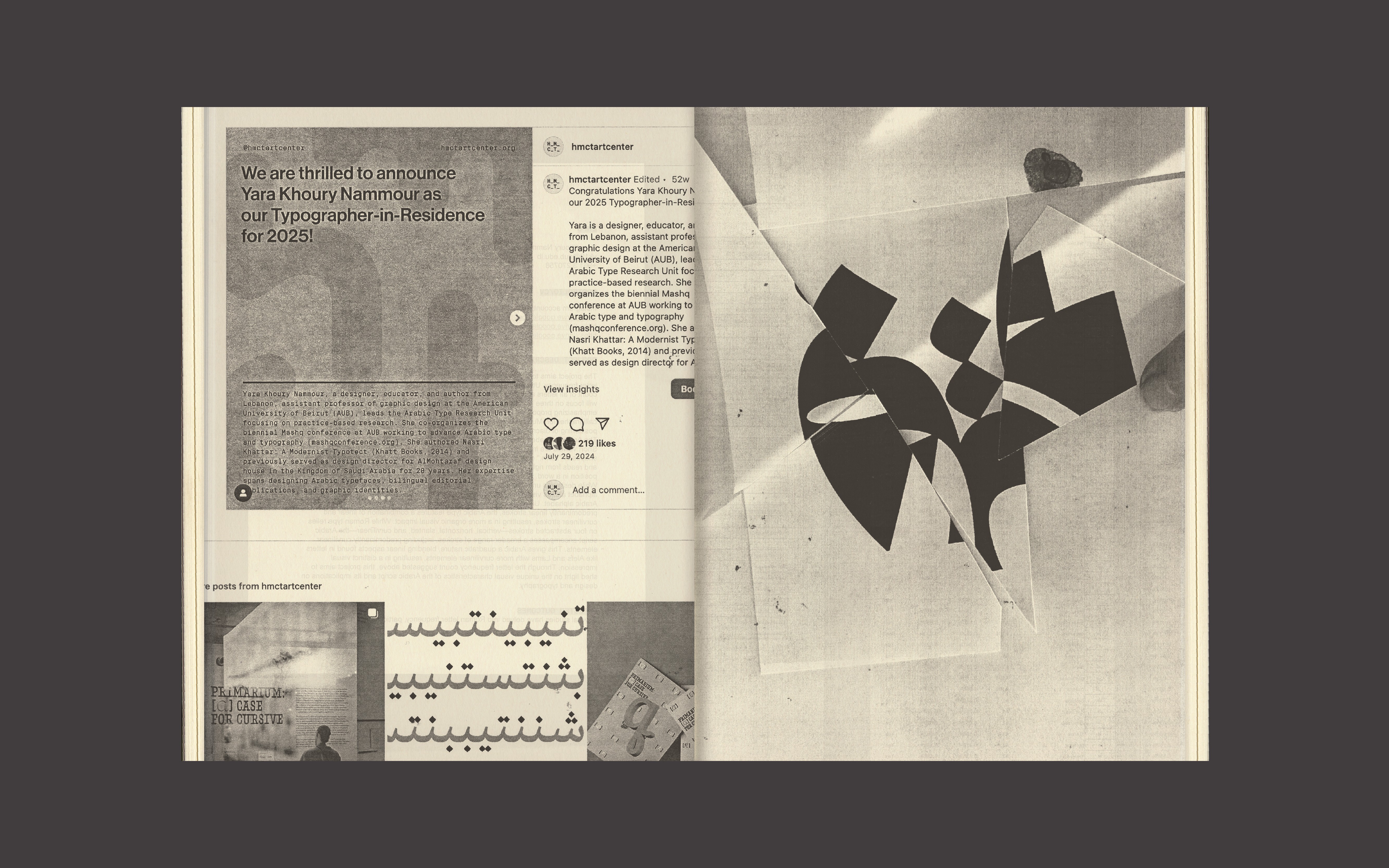
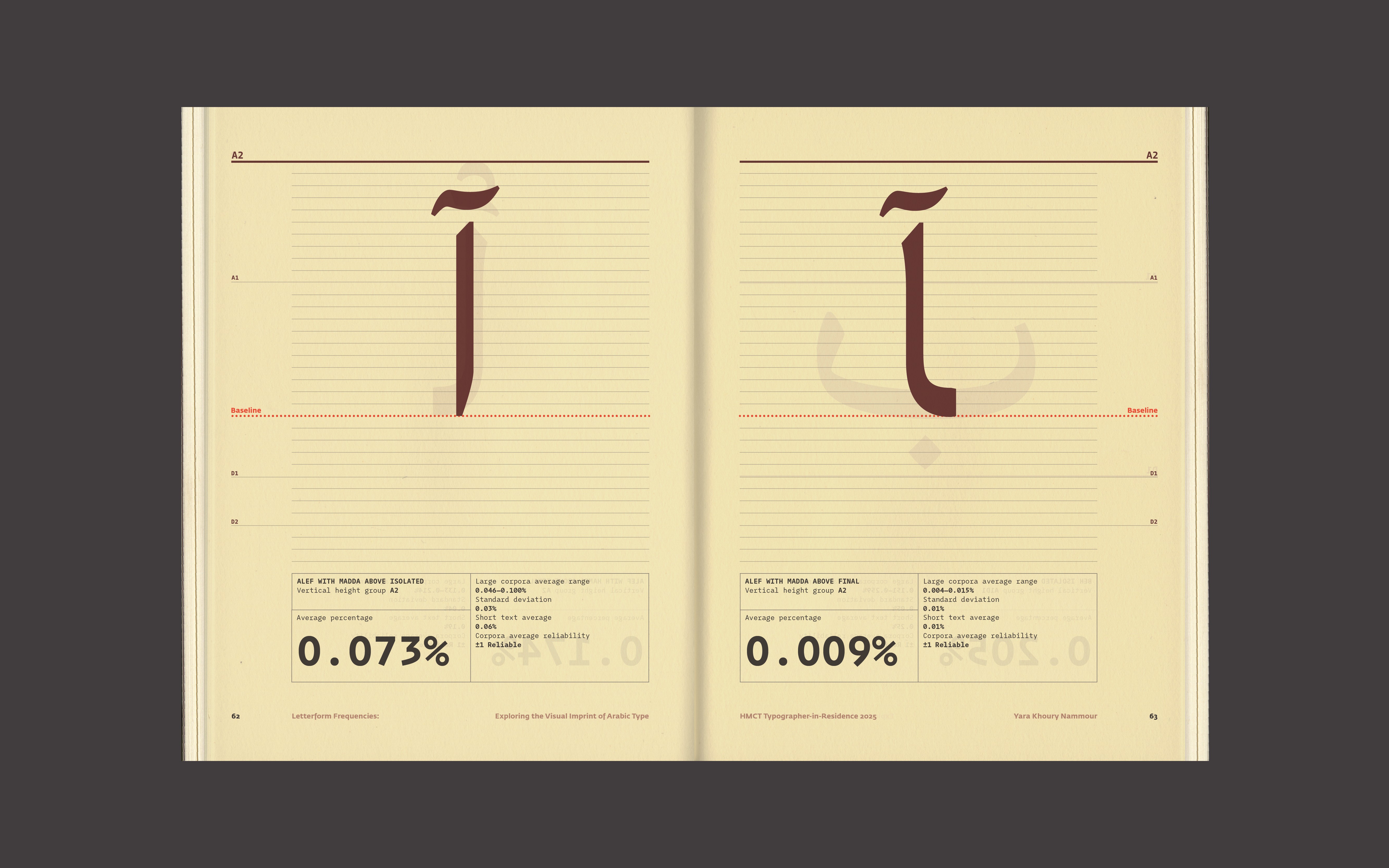
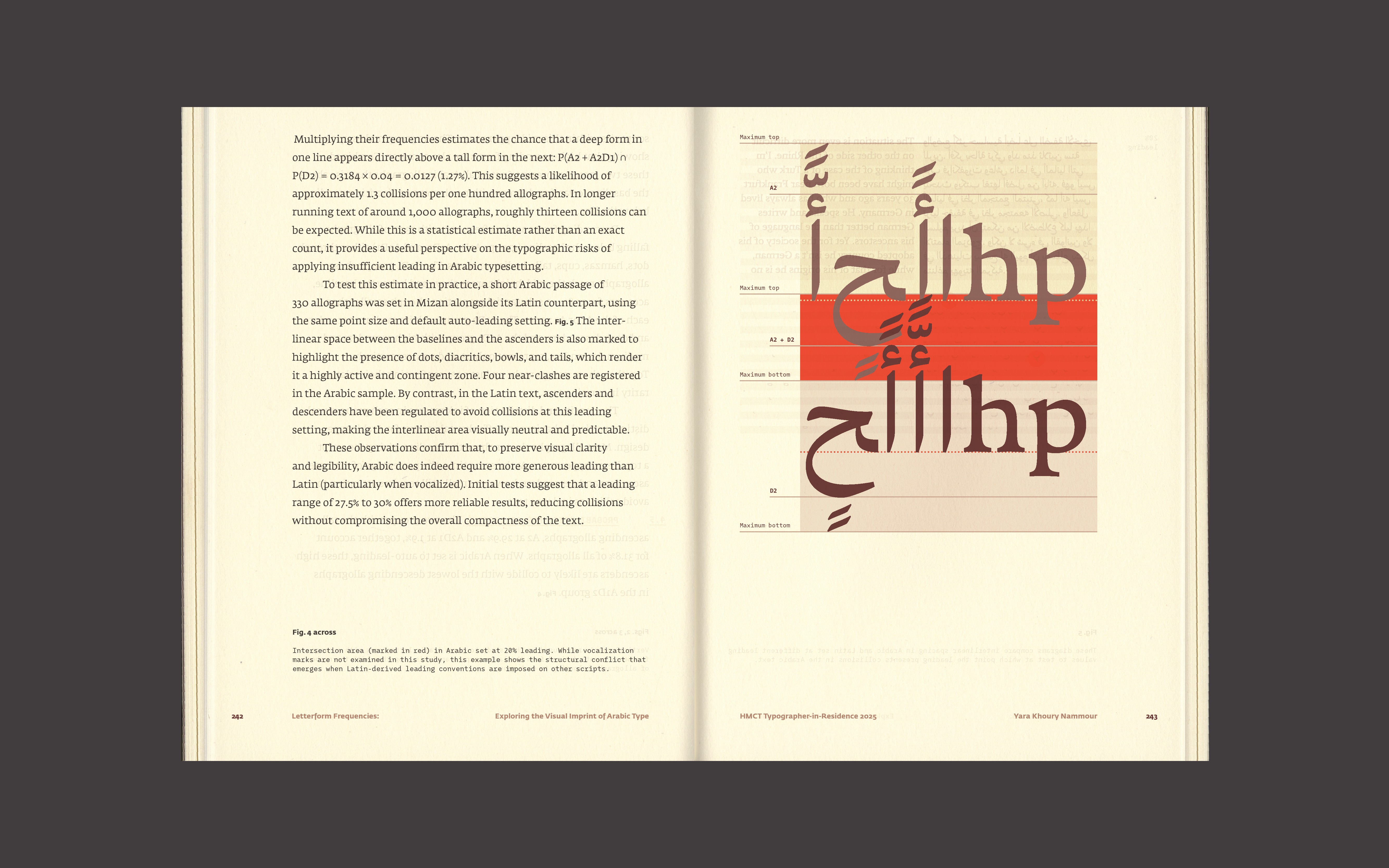
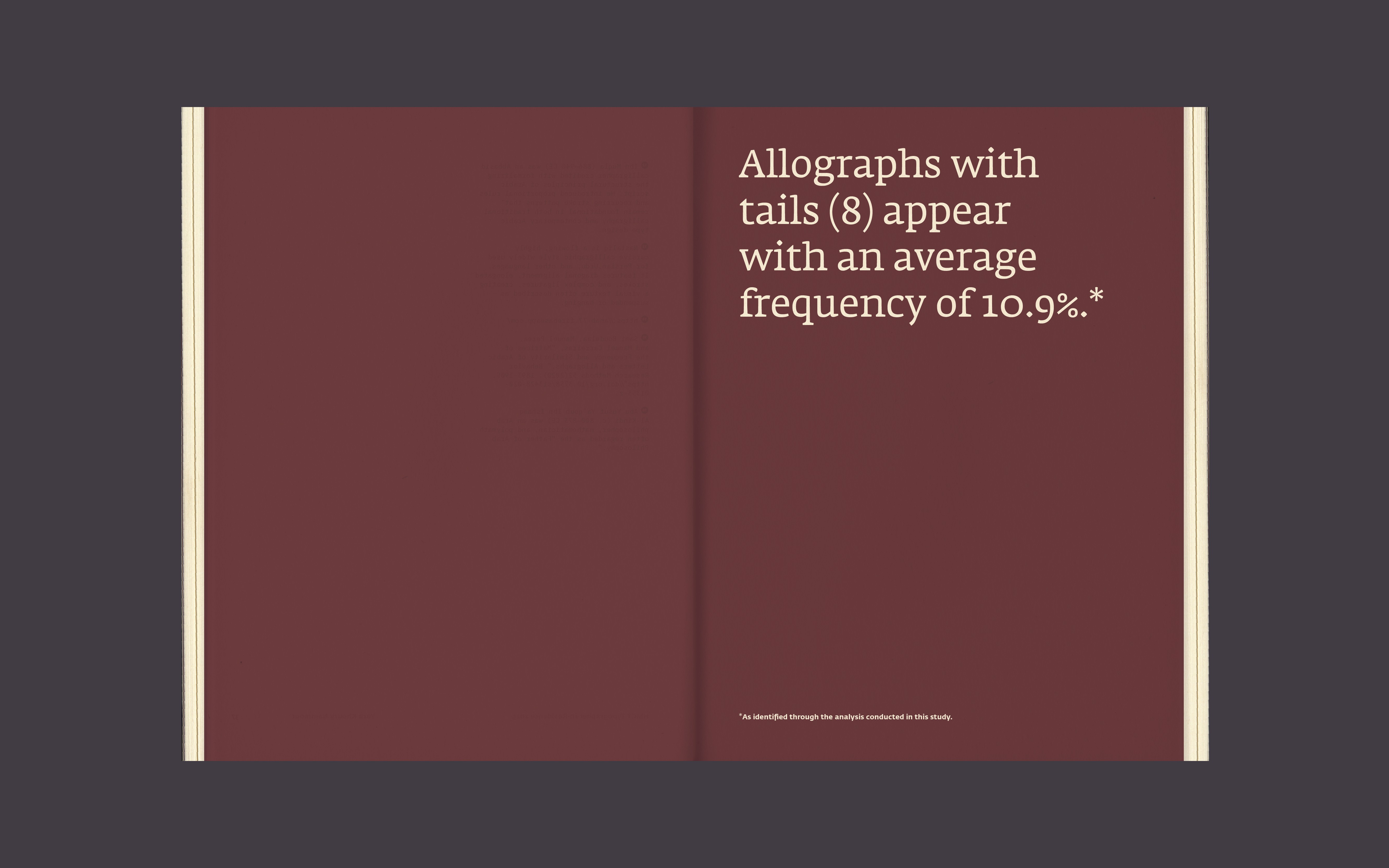
This publication documents the research developed by designer, educator, and author Yara Khoury Nammour during the 2025 Typographer-in-Residence program at the Hoffmitz Milken Center for Typography (HMCT) in Pasadena, California. Khoury Nammour leads the Arabic Type Research Unit at the American University of Beirut (AUB), where her work focuses on practice-based research in graphic design and Arabic typography. She is also co-organizer of the biennial Mashq conference at AUB, dedicated to advancing discourse around Arabic typography, and author of Nasri Khattar: A Modernist Typotect (Khatt Books, 2014). Each year, the HMCT Typographer-in-Residence program invites a practicing designer, type designer, or researcher to pursue a self-directed investigation centered on language and typography. The four-week residency provides time, space, and institutional support for the development of experimental and research-driven work. Khoury Nammour was selected for her proposal examining the visual imprint of Arabic type through the study of letter frequency and allographic patterns in continuous text. | The project explores the forms and structure that shape the Arabic script, investigating how allographic patterns and letter frequency contribute to its visual rhythm. Unlike the comparatively linear and rhythmically consistent structure of Latin typography, Arabic script is cursive, and contextual. While Latin typography has long benefited from quantitative and structural studies that inform contemporary type design, Arabic typography continues to rely largely on aesthetic intuition and inherited conventions. Through the analysis of frequency, repetition, and contextual variation, this research proposes new ways of understanding the visual behavior of Arabic text and the forms that shape its typographic identity. Combining research material, visual analysis, and process documentation, the publication traces the development of the project throughout the res idency while contributing to broader conversations on Arabic typographic research and contemporary design practice. Published in collaboration with Khatt Books and Draw Down Books. |